Circufair
Platform
Magento → Shopify
Product data
PIM
We built the Circufair store from scratch on Shopify, moved the entire product catalogue over from Magento without losing data or search visibility, and connected a PIM system so the client can run the catalogue themselves as the assortment grows.
Visit website
Circufair furnishes offices in the Netherlands the circular way. Instead of selling a replacement for everything, they start by taking stock of what an organisation already has, work out what still holds value, and only then propose what to keep, refurbish or buy. The shop covers office chairs, desks and sit-stand workstations, acoustic booths, storage and meeting furniture, and it is backed by more than fifteen years of office furnishing experience.
Headquarters
Joure, Netherlands
Market
Netherlands
The main idea that Circufair preaches
Start with insight. Understand what is already in the building before deciding what to replace — a better workplace and a smaller footprint come from the same decision.
A circular business sells the same product twice. Its webshop has to handle that — and most webshops are not built for it.
The client wanted to launch a new brand with its own positioning, and to move off Magento in the process. Magento gave them more platform than they needed: every change meant development time, and the team could not run their own shop day to day. At the same time the existing product data — years of photography, descriptions, specifications and pricing — could not simply be thrown away.
So the brief had two halves that usually pull against each other: build something new and clean on Shopify, and carry the entire existing catalogue across without losing product data, URLs or the search visibility that had already been earned.
Tech stack
We built the storefront from the ground up around the way Circufair actually sells. The homepage does not open with a product grid — it opens with the offer to take stock of your office first, because that is where their sales conversations start. Product listings, filtering, collection pages, cart and checkout were all built to keep that path short, and the whole store was set up so the client's own team can publish and edit without waiting on a developer.
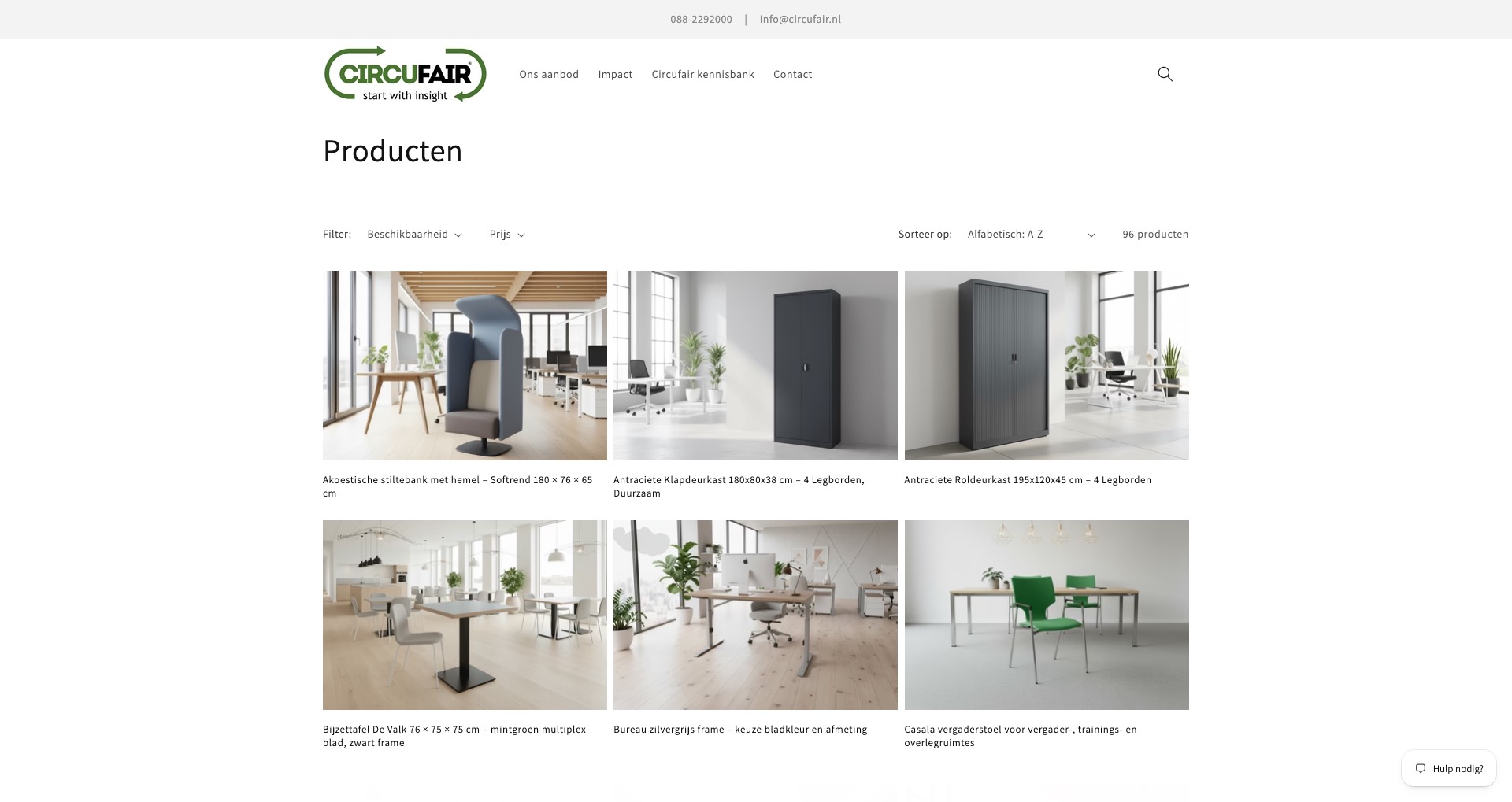
We moved the catalogue across from Magento in full: products, variants, images, descriptions, specifications, pricing and category structure. Magento and Shopify model products differently — options, variants and attributes do not map one to one — so the migration was not an export and an import but a translation between two data models, with validation on both ends to confirm nothing was silently dropped or mangled along the way.
A replatforming is where most shops quietly lose their organic traffic: URLs change, redirects are forgotten, and rankings built up over years disappear within weeks. We treated that as a first-class requirement — mapping the old URL structure onto the new one, putting redirects in place, and carrying over the metadata and structured content that the old catalogue pages had earned. The point of a migration is to change the platform, not to restart the traffic from zero.
Circular assortment changes constantly: stock is one-off, condition matters, and the same model can come back in a different state. We connected a PIM system so product information lives in one place and the storefront consumes what the PIM publishes. Adding or updating an item is now a content job rather than a development job, which is what lets the catalogue grow at the speed the business grows.
For a shop like this, organic search is the main channel: people look for a specific chair, a specific desk, or for sustainable office furnishing in general. We structured the collections and product pages so each one targets real demand and carries the specifications buyers compare on — dimensions, materials, condition. Combined with the knowledge base the client publishes, that gives the domain something to rank with beyond the product grid itself.
The store is live and the assortment keeps expanding. We continue to work with Circufair on the catalogue, on conversion and on the organic channel — because a circular business grows by being found by the right buyer at the right moment, and every improvement there shows up directly in their orders.
We worked in short, visible increments: an agreed scope, a traceable repository history, and regular calls to review what shipped and decide what came next. Migration work in particular was verified against the source catalogue before go-live, so the launch was a switch-over rather than a leap of faith.