AAteile
Part categories
1000+
Language versions
3
We built the AAteile online store from the ground up: a Shopware storefront fed by several supplier catalogues, enriched with technical automotive data and wired into a PIM system, so the team can sell across more than a thousand part categories in Germany, France and the rest of Europe.
Visit website
AAteile is a car parts retailer selling both original and refurbished components — engines, gearboxes, turbochargers, injectors, brakes, filters and body parts — to private drivers and to workshops. The company operates from Kehl on the German–French border and ships across Germany, France and the wider European market. Its catalogue covers more than a thousand part categories and dozens of manufacturer brands.
Headquarters
Kehl, Germany
Markets
Germany, France, Europe
The main idea that AAteile preaches
Give every driver and every workshop a way to find the exact part that fits their vehicle, at a fair price, without guesswork — whether the part is new or professionally refurbished.
In the car parts business the hardest question is not “what does it cost” — it is “will it fit my car”. Everything we built answers that question.
The client had suppliers, stock and ambition — but no online sales channel. Product information arrived from several different sources, each with its own format, its own naming and its own level of completeness. Nothing was standardised, and a catalogue of this size cannot be maintained by hand: a single part can fit hundreds of vehicle variants and carry dozens of OEM cross-reference numbers.
The task was to build the whole commercial operation from scratch — the store, the product data pipeline and the day-to-day processes behind them — and to make the catalogue findable in organic search from day one.
Tech stack
We chose Shopware as the platform because a car parts catalogue is not a normal catalogue. It needs deep faceted navigation, fast search across hundreds of thousands of items, and a data model that can carry vehicle compatibility alongside ordinary product attributes. We built the storefront, the category structure, the checkout and the customer accounts, and we shaped the whole front end around one job: getting the buyer to the part that fits their vehicle in as few steps as possible.
Stock and pricing come from several suppliers at once, and each of them delivers data differently. We built an ingestion pipeline that pulls those sources in, maps them onto a single internal product model, resolves duplicates between suppliers offering the same part, and keeps availability and prices in sync. The result is one clean catalogue for the customer, no matter how many systems sit behind it.
Raw supplier data is thin: an article number, a brand, a price. That is not enough to sell a part and not enough to rank in search. We enrich every item against the industry technical catalogues, so each product page carries the manufacturer, the article and EAN numbers, the OEM cross-reference numbers used by workshops, the fitting position on the vehicle, the technical specification and the full list of car models the part fits. This is what turns a spreadsheet row into a page a buyer — and a search engine — can actually understand.
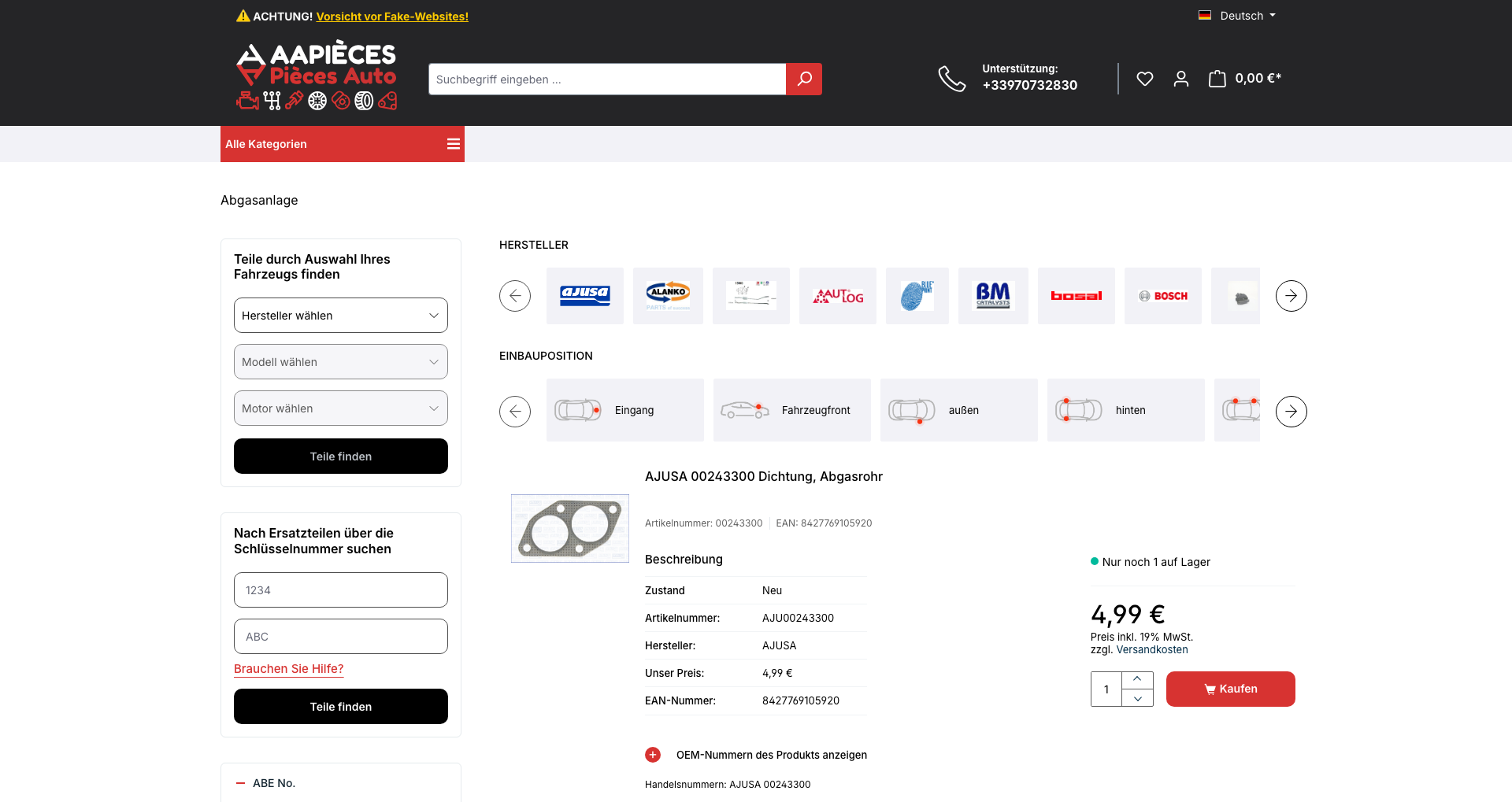
A buyer should never have to know a part number. We implemented three ways into the catalogue: picking manufacturer, model and engine step by step; entering the German vehicle key number (HSN/TSN) from the registration document; or entering the vehicle VIN. Each route resolves to a specific vehicle and filters the entire catalogue down to parts that are confirmed to fit it. This single feature removes most of the pre-sales questions that would otherwise land on the support team, and it cuts the number of wrong orders and returns.
We connected a PIM system so that product information has a single home, separate from the storefront. Content editors work in the PIM; the store consumes what the PIM publishes. Around it we digitalised the operational flow — how new supplier data enters the system, how it is validated and approved, how translations are managed and how an item finally goes live. What used to be manual work became a repeatable process, which is the only way to keep a catalogue of this size correct.
The store runs in three language versions — international English, German and French — each a full catalogue in its own right. We set up the language structure, the switcher and hreflang annotations so that search engines show the right version in the right market instead of competing with themselves.
On top of that, the enriched data gives every part category a page worth ranking: real specifications, real compatibility lists, real cross-references. We keep working on the organic channel with the client — technical SEO, catalogue structure and content — because for a business with this many pages, organic search is the cheapest way to grow orders.
The store is live and growing, and so is our involvement. We continue to extend the catalogue, connect new suppliers, deepen the product data and work on the organic channel together with the client. Every new part category that ranks, every wrong order that never happens and every support question that answers itself on the product page turns into revenue for AAteile — which is exactly how we measure our own work.
We ran the project with full transparency: documented scope and progress, a traceable repository history, and regular calls with the client to review what shipped and to agree what comes next. The client always knows what has been done, what is in progress and what the next release will bring.